CCADR Journal for Alternate Dispute Resolution
The CCADR Journal for Alternate Dispute Resolution is an academic publication of CCADR, CNLU. The Journal seeks to provide a scholarly platform for research, analysis, and critical discourse on contemporary developments in ADR.
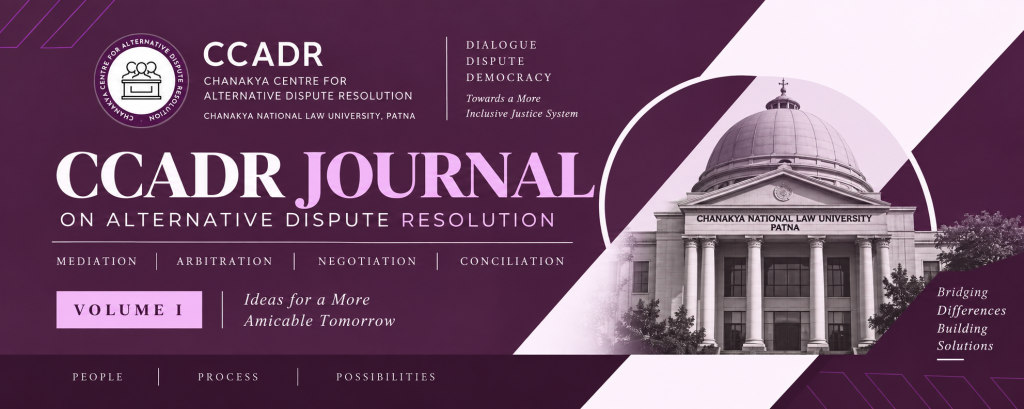
Home » CCADR Journal for ADR
CCADR Journal for ADR
- Current Issue: VOL. I
- THEME: Navigating the Expanding Role of Mediation and Arbitration in Dispute Resolution
About the Journal
The Centre seeks submissions under the following categories:
Long Articles — 6,000 to 8,000 words.
Short Articles — 3,000 to 6,000 words.
Case Comments/Book Reviews — 1,500 to 2,000 words (exclusive of footnotes).
The manuscript must contain an abstract between 250 to 500 words in italics along with 5 keywords.
The CCADR Journal for Alternate Dispute Resolution is an academic publication of CCADR, CNLU. The Journal seeks to provide a scholarly platform for research, analysis and critical discourse on contemporary developments in ADR.
The Journal encourages contributions addressing significant legal and practical developments in mediation and arbitration, including international commercial arbitration, investment arbitration, finality of awards, regulatory developments and technology-driven dispute resolution.
Theme
Navigating the Expanding Role of Mediation and Arbitration in Dispute Resolution
Sub Themes*
- International Commercial Arbitration
- Investment Arbitration
- Finality of Awards
- Policy and Regulatory Developments in Mediation
- Technology, AI, and Online Dispute Resolution
* The themes listed above are indicative and non-exhaustive. Submissions addressing related or emerging issues within the broader scope of the journal are also welcome.
PRIYANSHU LUCKY, Editor-In-Chief
+91 97987 01071
ANKITA KUMARI, Convenor
+91 93046 85878
AKSHAT ANUNAY, Senior Editor
+91 91227 91412
SHALINI SINGH, Deputy Editor
+91 99058 23548
SUMEDHA SINGH, Co-Convenor
+91 9142337424
PRIYASHA PRIYADARSHNI, Co-Convenor
+91 99715 45406
Contribution Guidelines
- The Centre seeks submissions under the following categories:
- Long Articles — 6,000 to 8,000 words.
- Short Articles — 3,000 to 6,000 words.
- Case Comments/Book Reviews — 1,500 to 2,000 words (exclusive of footnotes).
- The manuscript must contain an abstract between 250 to 500 words in italics along with 5 keywords.
- Each manuscript may have a maximum of two authors. Co-authorship beyond two authors shall not be permitted.
- The final manuscript will be accepted for consideration only if the corresponding abstract has been selected.
- The manuscript must be in conformity with the Bluebook 21st edition. The author(s) are required to mandatorily adhere to the same.
- The manuscript must not contain any mention of or reference to the author’s name, affiliation or credentials. Such information must be restricted to a separate cover page which must contain a brief biographical description of the author and include the authors’ name, affiliation, qualifications and contact details.
- The manuscript must be contained in a Microsoft Word (.doc/.docx) document.
Formatting Guidelines
- The language setting of the manuscript must be English.
- The manuscript shall use Times New Roman font, size 12, with justified alignment and line spacing of 1.15 for the main body text.
- Footnotes shall be in Times New Roman font, size 10, with left alignment (ragged) and single line spacing of 1.15.
- The page size must be A4 with margins of 2.54 cm on all sides.
- Page numbers must be placed at the bottom centre of each page in Times New Roman font, size 11.
- Headings and sub-headings must follow a clear hierarchical structure, with primary headings numbered using Roman numerals (I., II., III.), secondary headings using capital letters (A., B., C.), and tertiary headings using lower-case Roman numerals (i., ii., iii.).
- All quotations must retain punctuation within the double quotation marks.
- Numbers from one to nine in the main text must be written in words, while numbers above ten must be written in numerals.
- Hyperlinks, if included, must not appear in blue or underlined; they must be formatted in black text while retaining the embedded link.
- Abbreviations must be defined at their first occurrence in the manuscript and used consistently thereafter.
- Abbreviations must appear in square brackets within double quotation marks and in bold. For example: [“ABC”]
- The format for dates must be Month DD, YYYY. For example: January 1, 2026.
- All hyperlinks and citations must be functional and verified at the time of submission.
- Authors, upon submission, must communicate their acceptance of the following conditions:
- The work, upon publication, becomes the property of Chanakya Centre for Alternate Dispute Resolution (CCADR);
- Permissions for subsequent publication/reprint and/or derivative works must be obtained from CCADR.
- CCADR follows a comprehensive double blind review procedure. CCADR shall endeavour to keep the authors informed about the current status of their manuscript as it goes through each stage of review.
- All manuscripts shall undergo a three-tiered editorial review process, as follows:
- First Stage: Preliminary Review: This stage shall entail a preliminary check of the manuscript for compliance with the prescribed submission and formatting guidelines, including word count, plagiarism and AI usage limits, and other applicable requirements.
- Second Stage: Blind Editorial Review: At this stage, the Editors shall assess the manuscript for its originality, structure, substantive quality, citations, and language.
- Third Stage: Blind External Review: Manuscripts shortlisted at the preceding stage shall be forwarded for review by an external reviewer(s) with relevant expertise. The final decision regarding publication shall be subject to the discretion of the Editorial Board.
- CCADR reserves the right to refer certain manuscripts to the Board of Advisors for review, based on the discretion of the Editorial Board.
- The acceptable limit of plagiarism is 15% (excluding citations), and that for AI usage is 10%. Manuscripts with plagiarism above 15%–20% will be subject to the discretion of the Editorial Board. AI usage between 10% and 20% shall be considered on the discretion of the Editorial Board.
- CCADR retains sole discretion over acceptance/rejection of manuscripts.
- CCADR does not entertain requests for advance decisions based on abstracts, topic proposals or outlines. Editorial decisions shall be based solely on review of the final manuscripts submitted by the authors.
- After review by the Editors, manuscripts may be returned to the authors with suggestions related to substance and/or style.
- CCADR reserves the right to request copies of any resources or authorities cited in the manuscript.
- Once submitted, the paper shall be perused on the following grounds –
- The manuscript would be peer reviewed. The journal follows a double-peer review process.
- Depending on the reviewer’s recommendations, the manuscript might be accepted absolutely, accepted with changes or rejected completely.
- In case the submissions are to be changed, the author shall do the needful in accordance with the instructions given and resend the same within the stipulated time.
Navigating the Expanding Role of Mediation and Arbitration in Dispute Resolution
Sub Themes*
International Commercial Arbitration
Investment Arbitration
Finality of Awards
Policy and Regulatory Developments in Mediation
Technology, AI and Online Dispute Resolution
* The themes listed above are indicative and non-exhaustive. Submissions addressing related or emerging issues within the broader scope of the journal are also welcome.
Abstract Submission
Authors are required to submit their abstracts by 11:59 p.m. on 15th October, 2026, via the Google Form link provided below.
Submission Form: https://forms.gle/8HcC66QB2dkzNpmd6
| Publication Timeline | Deadline |
|---|---|
| Last Date of Submission of Abstract | 15th October, 2026 |
| Notification of Abstract Acceptance | 25th October, 2026 |
| Last Date of Submission of Final Manuscript | 30th November, 2026 |
| Tentative Publication | March, 2027 |
- VOLUME-I
- Theme: Navigating the Expanding Role of Mediation and Arbitration in Dispute Resolution
- Name of Publisher: Chanakya Centre for Alternative Dispute Resolution (CCADR), Chanakya National Law University (CNLU), Patna
- Complete Postal Address: Nyaya Nagar, Mithapur, Patna, Bihar – 800001,
- E-mail: editorial.ccadr@cnlu.ac.in
- PRIYANSHU LUCKY, Editor-In-Chief: +91 97987 01071
- PRIYASHA PRIYADARSHNI, Co-Convenor: +91 99715 45406
- E-mail: editorial.ccadr@cnlu.ac.in
- Website: www.ccadr.cnlu.ac.in